
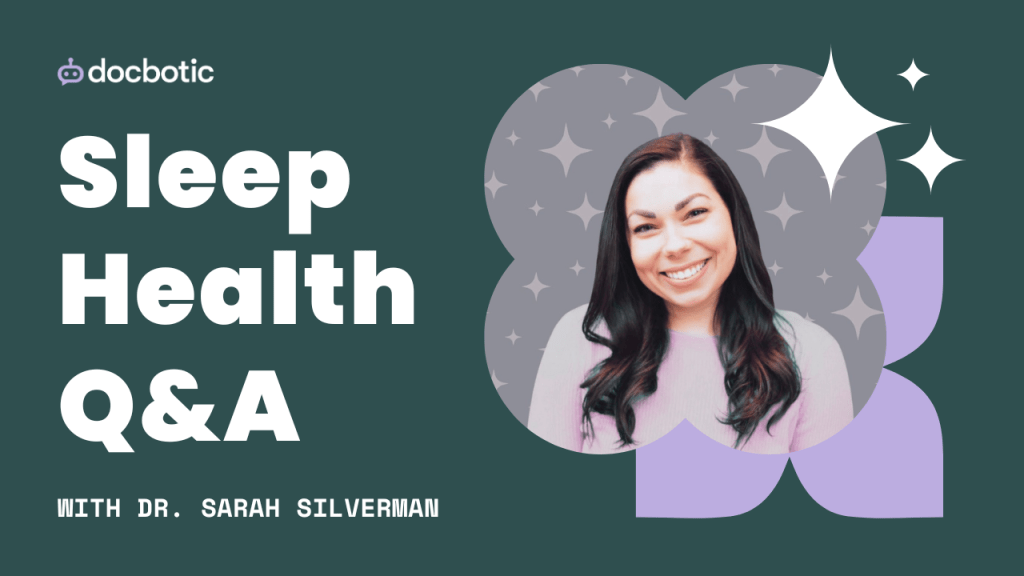
Our very own Dasha Geller recently sat down with Dr. Sarah Silverman, a holistic sleep expert and friend of docbotic, to answer your sleep questions.
We love Dr. Silverman for her focus in long-term sleep health, her advocacy for the oft-ignored issue of women’s sleep health, and for generally being an amazing human being! In their conversation, she generously shared her insights and offered actionable advice rooted in her extensive experience and training.
Below is a summary of their interview, which you can watch in full on Youtube.
What is the best way to the stop anxious thoughts that keep me from falling asleep?
It’s tragically normal for stress and anxiety to affect sleep. Dr. Silverman recommended addressing these worries earlier in the day, ideally a few hours before bedtime. She walked us through a constructive worry exercise, which involves writing down worries and identifying actionable steps to address them. This practice helps the brain process concerns during waking hours, reducing their interference with sleep. I do this almost compulsively because it works!
Why don’t I feel rested after getting 8 hours of sleep?
Feeling tired despite sleeping “enough” can result from disrupted sleep, circadian misalignment, an underlying sleep disorder like obstructive sleep apnea, among other factors. Dr. Silverman emphasized that sleep quality matters more than the quantity of sleep—so don’t worry about getting a solid 8 hours every night.
When should I go to bed and wake up?
Dr. Silverman introduced the concept of chronotypes to us, an individual’s predisposition to a specific sleep schedule. Most people are bears, waking and sleeping at socially “normal” hours, but there are also lions, wolves, and dolphins! Understanding your chronotype can help align your sleep schedule with your natural circadian rhythm for improved sleep.
How do I deal with tooth grinding, aka bruxism?
Teeth grinding can be stress-related or linked to breathing issues like sleep apnea. It’s crucial to identify the underlying cause and seek a sleep evaluation from a specialist.
How can I stop having nightmares?
Dream scripting: a technique to train the brain to have more positive dreams. By scripting positive dreams during the day, you can encourage good dreams at night and gradually replace nightmares or bad dreams 🤯
Why shouldn’t I hit snooze for an hour?
Turns out, those 8 minute bouts of stolen sleep aren’t restful. Dr. Silverman recommended setting the alarm for the latest possible wake time. Ultimately, consistency in waketime is essential for regulating the circadian rhythm.
Will sleeping in on the weekends make up for my sleep debt?
Trying to catch up on sleep during weekends can disrupt the circadian rhythm, leading to a cycle of poor sleep. It’s best to maintain a consistent wake-up time every day to regulate the internal body clock effectively.
When can I use meds to help me sleep?
Dr. Silverman views medication as a tool—helpful for short-term sleep stabilization. She recommended consulting with a healthcare provider to create a personalized plan for gradually tapering off medication, emphasizing the importance of learning natural sleep skills for long-term sleep health.
How can I break the cycle of daytime sleepiness and disruptive naps?
Dr. Silverman acknowledged that daytime sleepiness can be a sign of underlying sleep issues like sleep apnea or bruxism, advising individuals who regularly experience daytime sleepiness to consult a sleep specialist.
In terms of naps, she highlights that everyone is different, but a general rule is to keep naps short (around 20-30 minutes) and schedule them before 2-3 pm to avoid interfering with nighttime sleep.
Should I use a sleep tracker?
Sleep trackers can be helpful for some people! However, Dr. Silverman also pointed out that for individuals struggling with insomnia, tracking sleep can increase anxiety and fixation on data. She recommended using sleep trackers for other purposes but not for assessing sleep quality, especially when dealing with sleep-related stress. She also highlighted that sleep trackers may not always accurately reflect sleep stages, so it’s essential not to rely too heavily on their data.
What should I do if I wake up in the middle of the night and can’t fall back asleep?”
Dr. Silverman taught us the concept of “stimulus control,” a technique from cognitive behavioral therapy for insomnia (CBT-i). This approach involves getting out of bed when you’re unable to sleep or feel frustrated and anxious about not sleeping. Engage in an enjoyable and relaxing activity in another room until you feel sleepy again, then return to bed. The goal is to associate your bed exclusively with sleep, not with anxiety or wakefulness.
Follow Dr. Silverman on Instagram, TikTok, and Youtube at @drsarahsleep and learn more at https://www.drsarahsleep.com/
 docbotic
Leave a comment